Opening and Cleaning
Upon arrival at the spinning mill, bales of raw fiber are opened. The densely packed tufts must be loosened and blended to ensure a uniform lot. In cotton processing, blowroom machinery uses beating mechanisms and air currents to separate impurities (dust, leaf fragments) from the fiber stock.
The Carding Engine
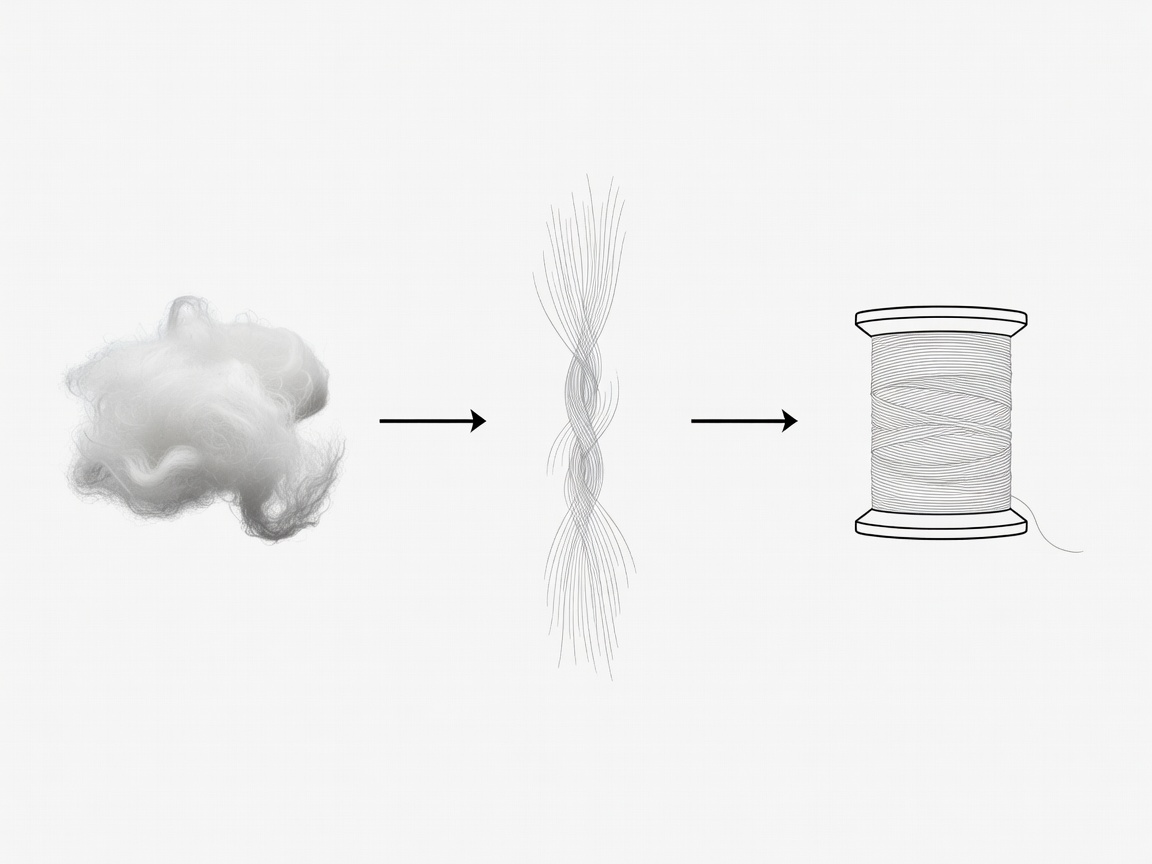
Carding is often referred to as the heart of spinning. The opened tufts are fed between large cylinders covered in fine wire teeth. This action disentangles the tufts, aligning the fibers into a thin, rudimentary web. This web is then condensed into a loose, untwisted rope known as a sliver.
Drafting and Roving
To reduce the thickness of the sliver, it undergoes drafting. Multiple slivers are fed through pairs of rollers rotating at successively higher speeds. This draws the fibers out, attenuating the mass while further parallelizing them. The resulting strand is then passed through a roving frame, which imparts a slight twist to hold the drafted fibers together, winding it onto bobbins.
The Mechanics of the Loom: Precursor Yarn Tensions
While weaving occurs later, the parameters of spinning are entirely dictated by loom requirements. Warp yarns (lengthwise threads) endure high tension and abrasive forces during weaving. Therefore, ring spinning is often utilized for warp yarns due to its superior strength profile.
Ring Spinning
The roving is drafted to its final thickness. Twist is inserted by a traveler revolving on a ring around a rapidly spinning spindle. It produces high-quality, strong yarn but is relatively slow due to physical limitations of traveler speed.
Rotor (Open-End) Spinning
Fibers are separated individually and fed into a rapidly spinning rotor cup. The centrifugal force throws the fibers into a V-groove, where they are twisted onto the tail of the forming yarn. This method is highly productive and ideal for coarser yarns used in denim.
Air-Jet Spinning
Compressed air vortexes are used to wrap outer fibers around a parallel core of fibers. This technique boasts extremely high production speeds and produces a yarn that is highly resistant to pilling, often favored for shirting fabrics.